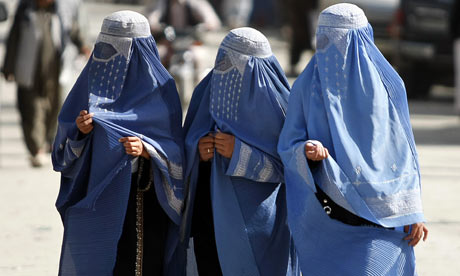
Beyond the usual interest and
concern that we should feel for fellow humans no matter where they live, the
plight of women in Afghanistan is not our business. They are merely at a point
in the evolutionary process that women in most parts of the Western World have
already passed. We tend to forget that women's suffrage was only gained in
Canada in 1918, and in the United States in 1920.
The women of Afghanistan will
procure more power within their society and greater human rights when they are
ready to fight for them, just as North American women did. At that time, no
outside nation would have dared to intrude and try to force Canadian or American
societies and governments to alter the customs of the day. The struggle had to
be launched and conducted by the women themselves.
Religious Muslims believe that
Western societies are degenerate and corrupt. If our military forces tried to
interfere in their established way of life, it would likely have a counter
effect. All Afghani citizens would unite in an effort to retain their
traditions and culture. It would take the women even longer to progress towards
equality with their male counterparts.
Think for a minute what our
reaction would be if Muslim forces descended on our cities and towns and tried
to force their traditions and customs on our society. Every citizen would be
ready to fight, with every means at their disposal, to repel the enemy. We
would cling even more ferociously to our cherished customs and way of life. The
Afghan people would react the same way, if outsiders tried to intrude and alter
the lifestyle they have created.
We can send the Afghan women our
prayers and good wishes as they wage their struggle to gain freedom from the
repression under which they live. Other than that, we should mind our own
business. The battle is theirs to wage. You can't stop progress. Sooner or
later they will prevail, and they will emerge stronger and more confident for
having wrestled the specter of male prejudice to the ground. We mustn't deprive
them of the opportunity to advance their cause through their own efforts.
Healthy eating has to be an
individual choice. No one can plead ignorance today, about what constitutes a
healthy diet. Unfortunately, because of an abundance of reasonably-priced food,
more sedentary life styles and careless eating habits, many of us have
abandoned the healthy nutritional practices which were a normal part of life
for our forefathers.
In our society, goodies are all
too available. There are donut shops on nearly every corner. Affordable
cookies, candy, and cakes beckon from the front shelves of variety stores. When
we entertain guests, we offer them coffee, tea and sweet treats. Our very
culture conspires to sabotage our healthy eating resolutions.
A large percentage of people in
the Western World are overweight, in spite of the fact that we know very well
what we should and should not be putting into our mouths. The truth is that we
have become sloppy in making wise food choices. It is too easy to hand Junior a
pack of Pop-tarts as he rushes off to school in the morning. Our grandmothers,
who were stay-at-home moms took the time to make hot porridge.
Working wives and mothers often
don't feel they have the time or energy to prepare supper from scratch. It's
too easy to pick up a "Happy Meal" on the way home from work. Our
grandmothers cooked every meal from scratch and french fries weren't even in
their vocabulary.
The answer to these poor food
practices is not in government legislation, but strengthening our determination
to provide better nutrition for our families. Modern products can be a help
here as well as a hindrance. Oatmeal now comes in instant packets, just add
boiling water, stir and serve. A ready-to-serve salad bowl is just as easy to
pick up as a Happy Meal. The choice must lie with individuals.
During Prohibition, the
government passed laws banning the sale of alcohol. The laws couldn't be
enforced, and they were soon repealed. Trying to legislate what people eat
would be even more problematic.
In addition, imagine the
consultants, the committees, the scientific studies, the medical experts, and
the dietitians that would be needed to decide which foods, drinks, additives,
etc., would be allowable for sale to consumers. Are you willing to have the
cost of those salaries on your next
income tax statement? I'm not.
It is outside the jurisdiction of
government to legislate what the citizens can or cannot eat. We should resent
being treated as children. Just as we accept responsibility for our own
personal safety, we must improve in adequately meeting our nutritional needs.
Otherwise, in addition to everything else, we may be asked to pay to combat the
black market in chocolate bars
A philosopher has been defined as
a thinker who deeply and seriously considers human affairs and life in general.
Western society as a whole is in
grave need of not just one, but a multitude of philosophers. We need them to
rescue us from the quagmire of misfortunes in which we've become enmeshed by a
series of non-thinking leaders, elected by citizens who themselves have not
been in the habit of thinking deeply and seriously enough about anything.
At present, since we're in the
grips of a global recession, the first team of philosophers should be
commissioned to study economics. How can we escape the financial ills of the
present and return our country to a position of financial stability?
This discussion would quickly and
inevitably lead to the topic of business ethics. Why were so many corporate
executives given huge salaries, exorbitant bonuses and gold-plated pensions,
even as their companies were teetering on the brink of bankruptcy?
Why did this disgraceful
situation continue for so long? Where were the watchdogs, the overseers? If
there were none, there should have been. Perhaps the philosophers can help us
choose competent monitors to oversee the day-to-day management of business
operations in an effort to keep them honest.
Why and how did we get involved
in bloody wars that are half a world away with people of a different culture,
most of whom are desperately poor and who have never lifted a finger to injure
any of us?
I realize that our society's
addiction to oil played a huge role in the invasion of Iraq, but a band of
Islamic fundamentalists planned and carried out the 9/11 attack. Was it really
necessary to invade Afghanistan and overthrow the entire government?
We know that more than 4,000
Allied troops and support staff have been killed by the enemy in the Middle
Eastern conflicts. But news of the hundreds of thousands of civilians in
Afghanistan and Iraq who have been killed and injured has been suppressed by
the media.
The philosophers should see to it
that every bit of the horror of these Middle Eastern wars is made public in our
country, complete with pictures, so that our citizens become aware of just what
devastation and suffering our leaders' belligerent attitudes have caused.
Then the deep thinkers should be
employed to plan how to restore America's image as a nation of peace and
justice to the world community. That task will be daunting, even for the most
clever. It will probably take years of demonstrating goodwill for any strategy to
be effective.
While we're waiting, there's much
work to do with the trillions of dollars that have previously been squandered
on military manoeuvres. The infrastructures of our cities are crumbling:
bridges are collapsing, sources of drinking water are becoming polluted; air
and soil pollution are causing an increasing number of cases of illness and
death among our citizens.
Thousands of hungry and homeless
souls in North America trudge the streets searching for any type of shelter.
The rate of unemployment is high and increasing daily. Only the well-off can
afford medical insurance. The skill level of students has fallen behind that of
children in many other countries. Our hospitals are understaffed and
overcrowded.
We will never regain our position
as a respected world leader as long as we tolerate these deplorable conditions
at home. There is enough planning and implementation of programs to be done to
keep teams of philosophers and their assistants busy for years. To suggest that
we need just one philosopher is ludicrous.
Where can these paradigms of
wisdom be found? They're probably out there, watching the decline of America in
stoical silence.
If you know of any, have them
forward their curriculum vitae to President Obama. He promised change. It is
high time for him to deliver on that promise, and he needs all the help he can
get.
 Have a cigarette?
If the answer is yes, you're one
of approximately 22% of Americans, or 1 in 4 people who smoke cigarettes. The
statistics are probably similar for Canada. Those numbers indicate that over 60
million people in North America are addicted to tobacco. Of that number, more
than 30 million, or half, will die of a smoking-related cause, many during
middle age.
Smokers are at greater risk of
death from heart disease, stroke, cardiovascular disease, cancer of the lungs,
mouth, throat, esophagus, stomach, bladder or pancreas. Female smokers have a greater
risk of developing cervical cancer.
Cigarette smoke contains over
4,000 chemicals, including 43 known cancer-causing compounds and 400 other
toxins. A partial list of these hazardous substances follows.
* Nicotine is a poisonous drug.
It is the main ingredient in insecticides or bug sprays. In its pure form, one
drop on a rabbit's tongue will kill it.
* Tar is the oily black substance
used to pave roads. When a smoker inhales, over a period of time, a lot of this
thick substance sticks to lungs and turns them black, instead of their normal,
healthy, pink color.
* Carbon monoxide is the
poisonous gas which comes from the exhaust pipe of a car. It interferes with
the function of the human respiratory and circulation systems.
* Arsenic and cyanide are deadly
poisons used to dispose of rats.
* Formaldehyde is used to
preserve samples of human tissue and the bodies of dead animals.
* DDT is an insecticide.
* Ammonia is found in many products
including those used for cleaning floors and toilets.
* Hydrogen cyanide was the lethal
gas used by Hitler's Nazis to kill people in the gas chambers.
* Methoprene is a pesticide.
* Acetone is an ingredient in
paint and nail polish remover.
* Chloroform is a gas used as an
anesthetic.
* Napthalene is the main
ingredient in mothballs.
A few of the other noxious
substances in cigarettes are lead, methane, ethanol, nitrous oxide and
methanol, but this gruesome list should be sufficient to convince any rational
person that smoking is definitely dangerous to health.
However, the body was designed
and created with a marvellous ability to heal and renew itself. When you quit
smoking-
· in 8 hours the oxygen level in
your blood returns to normal
· in 2 days, your senses of taste
and smell begin to improve.
· in 3 days, breathing becomes
easier and lung capacity increases.
· within 3 months, blood
circulation improves and lung capacity increases up to 30%.
· within 6 months, coughing,
tiredness and shortness of breath improve.
· within 1 year, the chances of
having a smoking-related heart attack are cut in half.
· within 10 years, the risk of
dying from lung cancer is cut in half.
· within 15 years, your risk of
dying from a heart attack is the same as someone who has never smoked.
There are more aids to help you
quit smoking now than there have ever been before. Your doctor can help you
choose one that will be safe and effective for you.
Then, the next time someone asks
if you want a cigarette, you can reply with justifiable pride, "No thanks;
I quit."
References:
The Lung Association
http://www.lung.ca/protect-protegez/tobacco-tabagism
e/quitting-cesser/benefits-bienfaits_e.php
About.com
http://quitsmoking.about.com/od/chemicalsinsmoke/a/c
hemicalshub.htm
Have a cigarette?
If the answer is yes, you're one
of approximately 22% of Americans, or 1 in 4 people who smoke cigarettes. The
statistics are probably similar for Canada. Those numbers indicate that over 60
million people in North America are addicted to tobacco. Of that number, more
than 30 million, or half, will die of a smoking-related cause, many during
middle age.
Smokers are at greater risk of
death from heart disease, stroke, cardiovascular disease, cancer of the lungs,
mouth, throat, esophagus, stomach, bladder or pancreas. Female smokers have a greater
risk of developing cervical cancer.
Cigarette smoke contains over
4,000 chemicals, including 43 known cancer-causing compounds and 400 other
toxins. A partial list of these hazardous substances follows.
* Nicotine is a poisonous drug.
It is the main ingredient in insecticides or bug sprays. In its pure form, one
drop on a rabbit's tongue will kill it.
* Tar is the oily black substance
used to pave roads. When a smoker inhales, over a period of time, a lot of this
thick substance sticks to lungs and turns them black, instead of their normal,
healthy, pink color.
* Carbon monoxide is the
poisonous gas which comes from the exhaust pipe of a car. It interferes with
the function of the human respiratory and circulation systems.
* Arsenic and cyanide are deadly
poisons used to dispose of rats.
* Formaldehyde is used to
preserve samples of human tissue and the bodies of dead animals.
* DDT is an insecticide.
* Ammonia is found in many products
including those used for cleaning floors and toilets.
* Hydrogen cyanide was the lethal
gas used by Hitler's Nazis to kill people in the gas chambers.
* Methoprene is a pesticide.
* Acetone is an ingredient in
paint and nail polish remover.
* Chloroform is a gas used as an
anesthetic.
* Napthalene is the main
ingredient in mothballs.
A few of the other noxious
substances in cigarettes are lead, methane, ethanol, nitrous oxide and
methanol, but this gruesome list should be sufficient to convince any rational
person that smoking is definitely dangerous to health.
However, the body was designed
and created with a marvellous ability to heal and renew itself. When you quit
smoking-
· in 8 hours the oxygen level in
your blood returns to normal
· in 2 days, your senses of taste
and smell begin to improve.
· in 3 days, breathing becomes
easier and lung capacity increases.
· within 3 months, blood
circulation improves and lung capacity increases up to 30%.
· within 6 months, coughing,
tiredness and shortness of breath improve.
· within 1 year, the chances of
having a smoking-related heart attack are cut in half.
· within 10 years, the risk of
dying from lung cancer is cut in half.
· within 15 years, your risk of
dying from a heart attack is the same as someone who has never smoked.
There are more aids to help you
quit smoking now than there have ever been before. Your doctor can help you
choose one that will be safe and effective for you.
Then, the next time someone asks
if you want a cigarette, you can reply with justifiable pride, "No thanks;
I quit."
References:
The Lung Association
http://www.lung.ca/protect-protegez/tobacco-tabagism
e/quitting-cesser/benefits-bienfaits_e.php
About.com
http://quitsmoking.about.com/od/chemicalsinsmoke/a/c
hemicalshub.htm
From a purely personal point of
view, I wish that gay public figures would stay in the closet. I have no
burning desire to know their favorite food, every detail of their past medical
history, what they wear to bed or their sexual preference.
I am interested in their
intelligence, their emotional stability, their moral outlook, and what they are
willing and able to contribute to the welfare of their fellow human beings,
world peace and environmental improvement. These are the areas of their personality
which will affect me. In all probability, I will not be on close enough terms
with any of them to need to know their sexual orientation.
To the best of my knowledge,
science has not discovered a cause or a cure for homosexuality. It may be a
genetic mutation, it could even be another form of "normal". I find
it difficult to believe that it's a choice. There have been too many homosexual
teenagers driven to depression or even suicide when they discover that they are
significantly different from the majority of their peers.
I believe, however, from the
viewpoint of the gay person who is, or who is about to become a public figure,
it would be wise to disclose their sexual preference as early as possible. The
press is certain to route out every secret on the family tree for at least the
past five generations!
If a gay entertainer stays in the
closet, he risks his future career being sidetracked by the
"shocking" disclosure when he is at the height of popularity. His
talent, as outstanding as it may be, could become a secondary issue to the
public's interest in the covert areas of his personal life.
In the case of a politician, some
important legislation which he is introducing or promoting could be shelved or
defeated solely because of the latent homophobic attitudes of some of his
fellow legislators. During strategic periods in a public figure's career, it's
vital that there be no shocking revelations about his private life to upset the
apple cart.
More important than sexual
orientation, to me and to many people, would be the day-to-day activities,
dignity and behavior of the public figure in question. Were he to appear nearly
naked, cavorting lewdly and loudly on a float in a Gay Pride Parade, he would
forfeit any respect, devotion, or loyalty I had previously felt for him.
Come to think of it, if he were
straight and carried on in that way, the end result would be the same.
Any individual, gay or straight,
in the public eye may not be able to control his food preferences or his
medical history, but he can and must be in control his behavior when he's on
the job or out and about.
Those celebrities who are wish to
be admired and to endure, must present acceptable images of themselves to all
people: men, women, teens and young children if they hope to remain for long
near the top of popularity polls.
My advice to gay figures in
public life: come out of the closet early in a straightforward manner , then
get on with your life. Practice honesty, self-respect and discretion. Conduct
all matters in such a way that, when your life is over, you' ll leave the world
and its people a little better off because you lived.
Come to think of it, that's not a
bad life plan for all of us. .
Smoking and the use of tobacco is
the single most preventable cause of illness and death in North America. More
than 400,000 Americans and 40,000 Canadians die every year from tobacco-related
illnesses.
In the United States, someone
dies every 72 seconds from smoking cigarettes, cigars or pipes.
Hospitals should not have designated smoking areas. On the contrary, the
director, board members and staff should do everything possible to prevent
those within their walls or on their premises from smoking.
Many of the patients are likely
in hospital as a result of tobacco use. Studies have shown that as much as 75%
of coronary artery disease may be caused by smoking.
Tobacco addiction increases the risk of cancer, respiratory diseases, dangers
during pregnancy, gastrointestinal problems and tooth and gum problems.
Smokers also suffer more sleeping problems, migraine headaches, coughs and
colds, high blood pressure, sinus congestion and disabling fatigue than nonsmokers.
There is really nothing positive to say about the use of tobacco.
Hospitals exist to fight illness. Why would they provide an area in which an
activity causing illness is permitted? It just doesn't make sense.
Who would be affected if a general ban on smoking in hospitals were enforced ?
First of all, the patients would be unable to smoke. This will only hasten
their recovery. If they are severely addicted, they could be offered a patch
program while they're in residence, to ease withdrawal symptoms. Who knows? The
experience might be the means of helping them overcome their addiction
permanently.
The visitors would have to refrain from smoking. Normal hospital visits should
be brief anyway, and the sight of a friend or loved one in poor health should
distract their attention from their habit, at least temporarily. They are free
to leave anytime.
The staff could not smoke: doctors, nurses, cleaners, orderlies and others. The
brightest among these groups will not be addicted anyway. They have seen
firsthand the results of the addiction: the pain, suffering, death, and the
distraught relatives of patients with smoking-related disease.
The addicts will have to take their breaks in their vehicles or perhaps
lounging against a lamppost on the street. Perhaps the associated inconvenience
or the onset of inclement weather will be the means of freeing them from the
slavery of their nicotine addiction. This would indeed be a blessing in
disguise.
In the United States, smoking bans fall under the jurisdiction of each state.
In Canada, they are regulated by each province.
In Ontario, where I live, smoking is banned in workplaces and indoors at all
public places. A recent law forbids smoking in cars while a child is present.
In an enclosed area like a vehicle a child will inhale more concentrated doses
of secondhand smoke, and this is harmful to his respiratory system, as well as
to other parts of his still-growing body.
For those who wish to quit
smoking, there are many aids available today. As well as patches, there are
pills, lozenges, inhalers, chewing gum, and smoking cessation programs. Family
doctors are knowledgeable about available resources and are glad to help each
patient find the best means to leave his addiction far behind.
Instead of having a designated smoking area, each hospital should have an area
dedicated to the liberation of those still enslaved by the nicotine demon. This
space could include information pamphlets, samples of available aids to kick
the habit, a recovered addict and a encouraging nurse-practioner to dispense
enthusiasm and courage to those wishing to quit.
It's true, the hospital may be losing future business. Nurses may soon have the
time and energy to care for their patients the way they would like to. Doctors,
no longer overworked, may remember your name from one visit to the next. Who
knows? Those seriously ill may even be able to get a house call.
Is anyone about to argue, that the sooner we dispense with the use of tobacco
products not only in hospitals but everywhere else too, the better?
Citizen journalists are more
trustworthy than professional journalists, and clever editors should take
advantage of their skills whenever they have an opportunity to do so. Authors
of frequent "Letters to the Editor" in the local newspaper will
provide names and reveal clues as to the literary ability of the writers.
If talented people are invited to
submit articles of interest on community affairs, they would probably be
thrilled to do so. Some will likely work for the pleasure of knowing their work
will be read and appreciated by friends and neighbors. Others may request a
small stipend for their efforts, but it will certainly be less costly than
paying for the column of a well-known feature writer.
The advantages of utilizing
citizen journalists are many. Among them are:
- Citizen journalists will report
on people, places or events in which they are personally interested. No one
gave them a definite assignment and told them when, where, and how long to
write the required article. The spice of their enthusiasm for the topic will
seep through into their writing, making it more interesting for readers.
- As a general rule, they will
take the time and the trouble to investigate subtle details which professionals
may overlook because of looming deadlines or other time constraints. No one is
looking over the shoulder of the citizen journalist urging him to finish in
time for the morning (or evening) edition.
-They do not have to bow to the
usual political stance of a particular newspaper or chain of publications. They
are free to report the truth as they see it. They are more likely to produce
completely unbiased copy and this could occasionally function as a good balance
to the usual editorial stance of the publication.
- Because they are independent
agents, citizen journalists will be anxious to merit repeat requests for their
efforts. Their articles are likely to be clear, well-organized, with correct
spelling, punctuation , and faultless grammar. They realize substandard work
will probably end up in the wastepaper basket. They are not used to having
imperfections corrected by an editor.
-Citizen journalists come from
all walks of society. Since they do not usually hang around with professional
journalists, they will bring fresh topics and different perspectives from those
readers have come to expect. Some additions will be welcomed, others may not.
In any case, it will provide valuable feedback to the staff as to which of
their features are most appreciated.
- Citizen journalists encompass
people from all age brackets. The high school senior writing about teenage
interests and events will attract one segment of readers. A retired grandparent
writing a column about upcoming seniors' events in the community will be avidly
scanned by another. Citizen journalists' efforts can be rotated to appeal to
different age groups either randomly or on a predetermined schedule.
Utilizing the talents of citizen
journalists creates a win-win situation. The writers gain experience in writing
for publication, and have the pleasure of receiving comments, compliments, and
recognition for their efforts. Editors gain access to columns with original
material, fresh insights, and diverse perspectives from various segments within
the community, either cost-free or for very modest remuneration.
Citizen journalists are more
trustworthy than professional journalists. They write for the sheer pleasure of
expressing their thoughts on paper, and their finished products will be as
perfect as they can make them. They have no hidden agendas and no time
constraints. They will write about what they know, so their facts will be
accurate and reflect the perspectives of those within their social circles and
age brackets. All these factors are bonuses which will be handed on a silver
platter to the clever editor who makes use of the considerable talents of
citizen journalists.